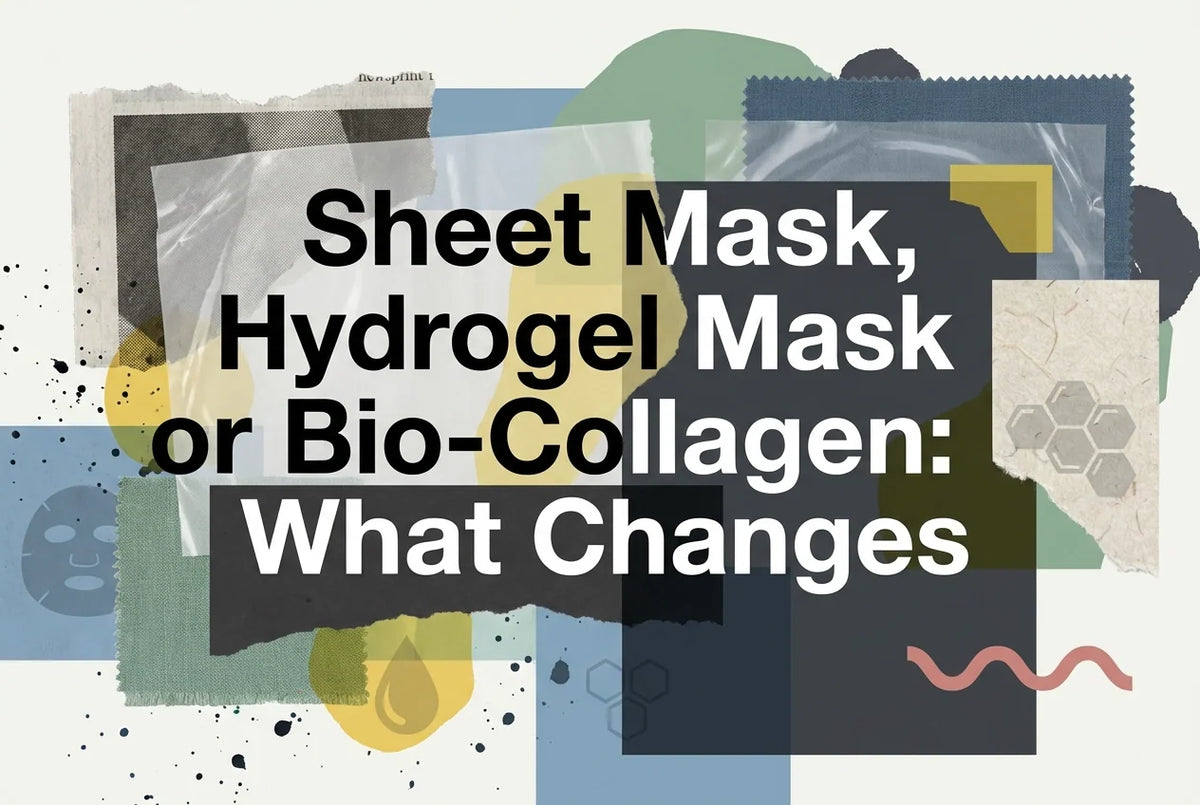
Choosing a face sheet mask can feel like decoding a tiny billboard. Hydrogel, bio-collagen, fibre, serum-soaked, overnight: the front of the packet is loud, but the format inside is what shapes your experience. This post is a beginner-friendly comparison of the three main formats. We will unpack why the wording on the packet matters less than the format, then look at contact time, occlusion, and serum retention, and what those things really change. From there, we will compare fibre face sheet masks for frequent use, hydrogel masks for longer and tighter occlusion, and gel bio-collagen masks for what the label does and does not promise. You will also get a side-by-side table, an honest look at whether paying more buys a better result, and a simple guide to choosing a mask for your face, skin, and situation. We will be upfront about our sources, the limits of the evidence, and our commercial relationship with Glow & Stow, then finish with key takeaways before your next mask. If you have ever wondered whether the price jump is worth it, start here.
Why the Wording on the Packet Matters Less Than the Format
The front of a mask packet sells a feeling: hydrating, firming, glow. The material inside decides something more practical. It sets how long the product stays on your face, how tightly it seals, and how much serum your skin is still in contact with at minute fifteen.
A fibre face sheet mask, a hydrogel mask and a gel bio-collagen mask are not good, better and best versions of the same thing. They are three different delivery systems, and each one is good at a different job. Sheet masks are widely reported as a staple of Korean skincare routines, with the ritual working because of the format, not the wording.
Searches like face sheet mask, facial sheet mask and sheet mask for face describe a category, not a format. Knowing which format sits inside the packet is the fastest way to stop buying masks that do not suit how you actually use them.
Brands can print any marketing word they like on the front. Material, thickness, sheet cut, stated wear time and serum volume are the things you can check before you pay. This guide compares formats, not brands. Where the independent evidence on sheet masks is thin, we say so rather than inventing a number.
Contact Time, Occlusion and Serum Retention: What a Mask Format Really Changes
The material decides what happens on skin through three things: contact time, occlusion and serum retention. Contact time is how long the mask sits on your face. Most fibre sheet packs suggest 10 to 20 minutes; check the printed instruction. Because they carry their own moisture, hydrogel formats are generally described as staying damp longer, though no head-to-head study confirms this. For more on wear times, see Sheet Mask vs Night Mask: The Core Differences Side by Side.
Occlusion is the seal. A wet layer slows evaporation, which is why a closer-fitting sheet feels more active. A preliminary study in Materials (Basel) examined one alginate hydrogel bio-mask formulation for skin hydration and barrier function, though its results are not yet available in full and it addresses one specific product rather than hydrogel sheets in general. As a practical matter, tighter fit tends to mean a better seal, and that is a format issue, not a serum one.
Serum retention is how much product remains in contact at the end. A sheet that dries and lifts early leaves less behind; one that holds moisture keeps working longer.
Fit matters more than material. Gaps around the nose, eyes and jaw let air in and break the seal, so a cheaper well-cut mask can beat a premium one that flaps.
One caveat: independent evidence separating format from formula is limited. Treat this as sensible practice, not proof, and follow the wear time on the pack.
Fibre Face Sheet Masks: The Frequent-Use Format
Fibre sheets are what most people picture when they search for a face mask sheet. Fibre sheets are typically non-woven fabric, cotton, cellulose or a synthetic blend, soaked in a water-based serum, which is why they feel like a damp cloth rather than a gel.
That construction suits frequent use. As a rule of thumb, price per wear tends to be low and the wear time short and tidy, which makes fibre a practical choice for a twice-weekly habit or a quick reset before bed rather than a splurge.
If your skin reacts easily, starting with a short, water-based format is commonly recommended as a cautious approach. Patch test on the inner arm or jawline first, and stop at any stinging, heat, itching or redness.
Fit is looser than hydrogel, so expect the occasional lifted edge. Smooth from the centre of the face outward, then press the jaw and nose edges down last, where lifting usually starts.
Squeeze the leftover serum from the packet and pat it into your neck, hands or décolletage instead of leaving the sheet on past its stated time or layering a second mask on top. If single-use waste bothers you, our guide to single-use masks and sustainability covers what conscious shoppers can check.
Hydrogel Masks: Longer, Tighter Occlusion for a Big Night
Unlike a soaked fibre sheet, hydrogel is a water-rich gel. Many hydrogel wearers describe a cooling sensation on contact, which is why this format is often suggested for hot evenings, post-sun skin and long baths, where fabric tends to slide.
Because it carries its own moisture, hydrogel is generally described as staying damp and in place longer than fibre. The payoff is longer, closer occlusion, which suits an event night, a flight or a wedding morning.
Hydrogel masks are often sold in two pieces, which lets you adjust for fit around the nose and jaw where single-piece sheets often leave gaps open.
The trade-off is price per wear. Hydrogel masks tend to be priced higher than fibre equivalents, so treat this as an occasional format rather than a weekly habit.
And do not chase extra benefit by overstaying the stated time. A hydrogel mask that has dried out is no longer doing the job it was sold for, and a longer wear is not automatically a better one. If you want the collagen-labelled version, our Best Collagen Format: Hydrolysed Collagen Sheet Masks guide unpacks that wording next.
Gel Bio-Collagen Masks: What the Label Does and Does Not Promise
Hydrogel's cling and cooling come from the material itself. With a gel bio-collagen mask, the wording on the front does much of the work. Hydrolysed collagen is a protein that occurs naturally in the dermis. By cosmetic-chemistry convention, hydrolysis breaks the protein into smaller fragments, allowing it to function as a film-forming or moisture-binding ingredient rather than putting collagen back into your skin.
No EU or UK regulatory definition for 'bio-collagen' has been identified; treat it as a marketing descriptor rather than a standardised category. It describes a manufacturing approach and a feel, so read it as a description of the mask, not a promised outcome.
What you are really buying is the format: a gel bio-collagen sheet generally gives the long, close contact time and slippery cooling finish of hydrogel, at a price that often reflects the name on the packet. Because the wording is loose, compare the specs you can see instead: stated wear time, serum volume, sheet dimensions and whether the cut suits your face shape. Our label check guide walks through this.
Be sceptical of medical-sounding claims such as rebuilding collagen or repairing skin. Cosmetic masks are not licensed medicines. Persistent concerns belong with a pharmacist, GP or dermatologist. Now, let's put the three formats side by side.
The Three Formats Side by Side
Strip away the label talk and you are choosing between three physical formats. Times below are brand-stated: the instruction on the pack, not a lab average.
Format |
Material |
Typical contact time |
Occlusion |
Serum load |
Price band |
Best situation |
|---|---|---|---|---|---|---|
Fibre sheet |
Non-woven fabric |
10–20 min (brand-stated) |
Low to moderate |
Moderate |
£ |
Frequent use, reactive skin |
Hydrogel |
Water-rich gel |
20–30 min (brand-stated) |
High |
High |
££ |
Big night, cooling |
Gel bio-collagen |
Gel sheet, collagen label |
Similar to hydrogel (brand-stated) |
High |
High |
££ to £££ |
Long wear, gel feel |
Contact times are brand-stated ranges from product packaging; occlusion and serum-load ratings are the authors' comparative assessments, not laboratory measurements.
Read across, not down. Decide whether you need frequent use, long wear, cooling or the tightest seal, then pick that row. Compare like with like on price: for example, if a mid-range hydrogel costs more per unit but you use it only four times a year, the annual spend may be lower than a cheaper fibre sheet used twice weekly, or higher, depending on the prices involved. Run the numbers for your own routine. Fit varies by face shape within every format, so a well-cut simple mask can beat a badly cut premium one. For a beginner-friendly collagen format, see our Best Collagen Format for Beginners.
Does Paying More Actually Buy a Better Result?
So when a mask costs more, you are paying for material, packaging, formulation and brand positioning as much as for performance. A higher price tag does not automatically mean a better result for your skin.
Run the cost-per-wear maths before you commit. Divide the price by how often you would honestly use that format in a year.
Premium is not the same as suitable. Reactive or sensitised skin should patch test every new mask, whatever it costs, and stop if a product causes stinging, heat or redness.
The specs in the table above, fit, wear time, serum volume, are the ones worth budgeting for.
If a price jump is justified only by a buzzword on the front, spend it on a format that matches your routine instead. Our guide to price vs. quality explains more, or put the money into the skincare steps you use every day.
How to Choose a Sheet Mask for Face, Skin and Situation

Price settled, the last question is simply which format suits you.
Fibre face sheet masks suit a weekly habit and a short wear time.
Hydrogel masks suit a big night, a holiday or any occasion when you want a longer, tighter seal.
Gel bio-collagen masks suit long wear and the gel feel.
Whatever the format: patch test first, keep to the stated wear time, and treat stinging, heat, itching or lingering redness as a stop signal rather than something to push through.
Match the mask to the moment. A Sunday reset, a wedding morning and an eight-hour flight all want different contact times, so keep more than one format in the drawer.
Two formats in rotation beats one premium packet you never reach for.
Our Sources and Commercial Relationship
So you've picked your format. Now, the honest bit.
Glow & Stow sells beauty tools and skincare, including hydrolysed collagen sheet masks, so we have a commercial interest in this topic. No brand paid for a placement here, and no third-party brands are ranked or recommended.
This is general information about formats, not medical advice. If you have a skin condition, are under treatment, or react badly to a product, speak to a pharmacist, GP or dermatologist.
Independent evidence comparing sheet mask formats is limited. That's why our mechanism claims stay descriptive, and any brand-stated figures are labelled as such rather than passed off as measured facts.
Our own shopping terms, for reference: free shipping on orders over £50, 24 to 48 hour tracked delivery, a 30 day money back guarantee, and Buy Now Pay Later through Klarna. You'll find more detail in our FAQs.
If stronger published research on occlusion, contact time or serum retention appears, we'll update this piece.
What to Take Away Before Your Next Mask
Caveats out of the way, here is the short version.
Buy the format, not the buzzword. Material, wear time and fit change what a mask actually does; the words on the front of the packet mostly change how it feels to buy.
The format-by-situation guide above covers which to reach for when.
Patch-test and stop-signal advice is covered in the section above.
Finally, spend your budget on the format that matches your routine, not the one with the best vocabulary. A cheap sheet you'll actually use twice a week beats a premium gel you never find a weeknight for. Your patience is part of the spec.
Conclusion
As the sections above show, format is the spec that matters most. As a next step, choose the format that matches your routine, then browse our range and confirm the specs before you buy. Shopping terms and FAQs are in our FAQ page.
Your patience is part of the spec. Pick the mask you will actually use, and let consistency do the rest.

Leave a comment
All comments are moderated before being published.
This site is protected by hCaptcha and the hCaptcha Privacy Policy and Terms of Service apply.