You've got a collagen sheet mask sitting on your bathroom shelf and a collagen night mask on your nightstand, and honestly, you're not totally sure which one is actually doing the heavy lifting. Sound familiar? You're not alone. These two formats get lumped together constantly, but using them interchangeably is one of the most common skincare mistakes women make, and it quietly costs you results.
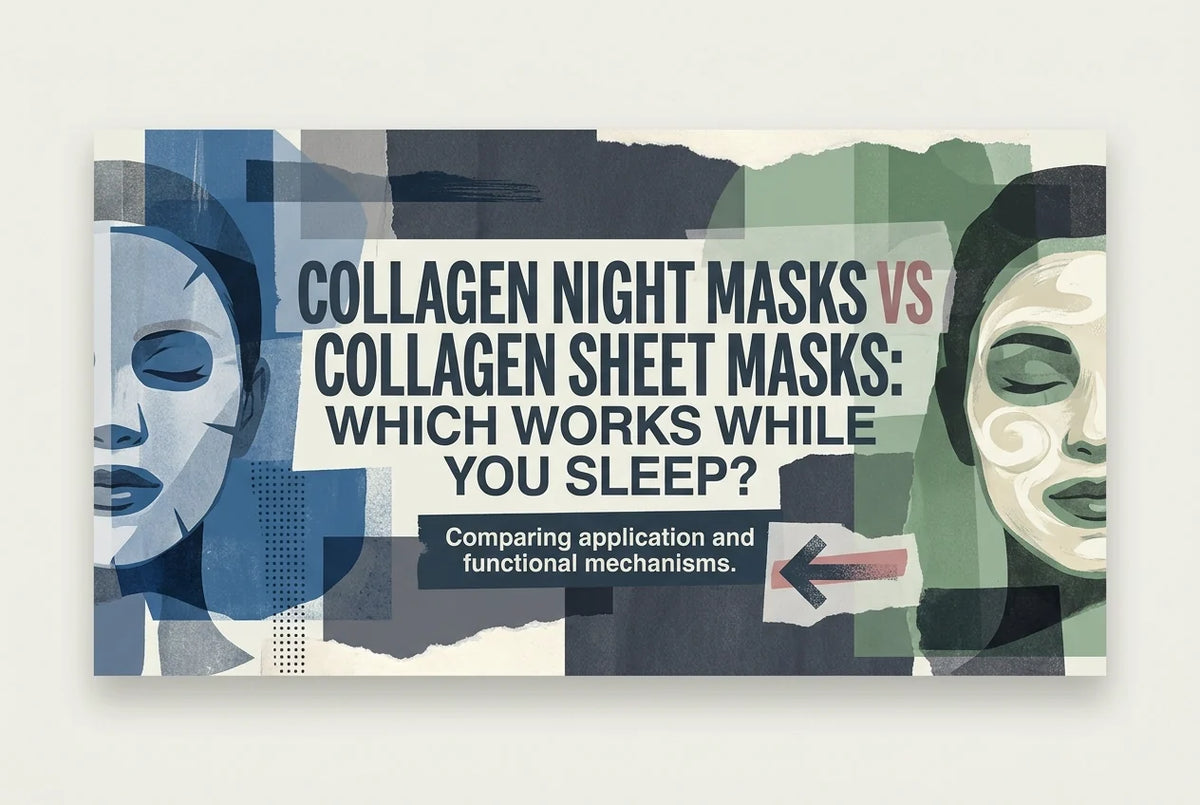
Here's the thing: a collagen sheet mask and a collagen night mask work through completely different mechanisms. One delivers an intensive burst of hydration in under 20 minutes through occlusion. The other uses slow-release emollients and humectants that work gradually across six to eight hours of sleep. Same hero ingredient on the label, very different jobs.
In this post, we're breaking down exactly how each format works, how hydrolysed collagen behaves under those two very different timeframes, and which option actually suits your skin goals and schedule. We'll also cover whether doubling up makes sense, and what to look for when you're shopping for either. By the end, choosing between the two will feel obvious.
Why These Two Masks Get Confused So Often
Pick up a collagen sheet mask and a collagen night mask in a beauty aisle and they look almost identical. Both promise plumper, brighter skin. Both shout "collagen" on the front. Both target the same concerns: fine lines, dullness, and dehydration. They are frequently shelved side by side, which does nothing to help shoppers distinguish one from the other.
The confusion is understandable, but it has real consequences. Use a sheet mask as an overnight treatment and you risk over-saturating your skin barrier with ingredients designed for short contact. Reach for a sleeping mask when you needed a quick pre-event glow and you simply will not get the result you were expecting. In both cases, you have wasted product and potentially your money.
The functional gap between these two formats is significant. Sheet masks work through a concentrated 15 to 20 minute occlusive burst. Overnight masks rely on slow-release emollients across a 6 to 8 hour sleep window. Different mechanisms, different formulations, different skin goals entirely. If you are weighing up collagen formats more broadly, this guide to collagen face cream vs collagen sheet masks covers another common overlap worth understanding.
The short answer: what determines results is timing and formulation, not the collagen claim on the label.
How a Collagen Sheet Mask Actually Works
The mechanism behind a sheet mask is simpler than most packaging suggests. When you press the sheet against your skin, it creates a sealed micro-environment: the physical barrier traps a concentrated serum directly against the surface, raising local humidity and preventing evaporation. This temporary occlusion is what makes the format work.
Under that sealed layer, hydrolysed collagen peptides and humectants are driven into the upper layers of the epidermis within a focused 15 to 20 minute window. Native collagen molecules are too large to cross the skin surface, which is why hydrolysed collagen matters here. The hydrolysis process breaks the protein into smaller peptides, sized specifically for efficient delivery under this short-contact, high-concentration model.
The result is an intensive hydration burst with a temporary plumping effect. Skin looks smoother and more even because the stratum corneum has drawn in moisture rapidly, not because collagen has rebuilt anything structurally. It is a fast, visible result, which makes the format genuinely useful before an event or at the end of a long day when you want your skin to look its best within the hour.
Once you peel the sheet away, there is no need to rinse. The residual serum left on the skin can simply be patted in, keeping the hydration benefit intact rather than washing it down the drain.
Glow and Stow's hydrolysed collagen sheet masks are formulated specifically for this occlusive window, delivering concentrated ingredients in the 15 to 20 minutes the format is designed for, with no lengthy routine required.
How a Collagen Night Mask Works Differently
The collagen night mask, also called a sleeping mask or overnight sleeping pack, takes the opposite approach. Rather than a concentrated 15-minute burst, it stays on skin for 6 to 8 hours, working gradually as you sleep.
The delivery mechanism is fundamentally different. Where a sheet mask uses occlusion to push ingredients in fast, an overnight mask relies on slow-release emollients and humectants that deposit moisture progressively as skin temperature rises during sleep. The formulation is designed for patience.
That extended window is genuinely useful because the skin's nocturnal repair cycle creates real biological opportunity. Circadian research confirms that nighttime skin behaviour prioritises cell renewal, DNA repair, and increased permeability, conditions that support sustained ingredient absorption rather than a rapid surface hit. Overnight masks are engineered to work with that biology, not simply sit on skin for longer.
Collagen in these formulations is typically anchored within heavier emollient carriers and film-forming agents rather than a water-heavy serum. This keeps the formula stable for hours without congesting pores or causing sensitivity. If you want to understand how this fits into a longer-term approach, integrating a collagen face mask into your broader beauty routine is worth reading alongside this comparison.
One important caveat: not every mask formula is safe for overnight wear. Ingredients suited to short contact, particularly high concentrations of exfoliating acids, can disrupt the skin barrier across 6 to 8 hours. Always confirm a product is explicitly formulated for extended wear before sleeping in it.
Longer contact time does not automatically mean better results. Formulation complexity determines efficacy, not duration alone.
How Hydrolysed Collagen Behaves Under 15 Minutes vs 8 Hours
So the formulation difference matters, but so does what the hydrolysed collagen is doing during each window.
Hydrolysed collagen consists of small, low-molecular-weight peptides, typically in the 3–6 kDa range. That size makes topical delivery feasible, but how much reaches the skin surface, and how quickly, depends heavily on the carrier and contact time surrounding it.
In a sheet mask, those peptides sit in a high-water-content serum held against the skin by an occlusive sheet. That sealed environment drives humectants and collagen peptides into the stratum corneum rapidly, producing the immediate plumping effect most people notice within minutes of removal. It is a concentrated burst: peak delivery happens fast, then stops when the mask comes off. This model suits specific, time-sensitive goals: a pre-event glow, rapid rehydration after a long-haul flight, or a weekly intensive treatment using a hydrolysed collagen sheet mask bolted onto an otherwise simple routine.
In an overnight mask, the collagen sits within a richer emollient matrix. There is no single peak delivery moment; instead, activity is lower at any given point but extends across the full skin repair window. That suits different goals entirely: sustained moisture replenishment through cold months, quiet barrier support, or tackling persistent dryness that 20 minutes simply cannot resolve.
The broader principle holding both together: clinical research consistently shows that formulation complexity drives results. Multi-component masks combining moisturising, repairing, and anti-ageing actives outperform single-function products, regardless of whether the format is a sheet or a sleeping mask.
Sheet Mask vs Night Mask: The Core Differences Side by Side
Those formulation differences translate into six concrete variables. Here they are side by side.
Collagen Sheet Mask |
Collagen Night Mask |
|
|---|---|---|
Application time |
15 to 20 minutes |
6 to 8 hours |
Delivery mechanism |
Occlusive burst hydration |
Slow-release emollient absorption |
Collagen format |
Hydrolysed peptides in a water-heavy serum |
Collagen within a richer emollient carrier matrix |
Skin state during use |
Awake, upright skin |
Pre-sleep skin with heightened nocturnal permeability |
Best outcome |
Immediate, visible result within 30 minutes |
Gradual, cumulative moisture replenishment across the sleep cycle |
Routine position |
Standalone treatment, 1 to 3 times per week |
Replaces your evening moisturiser on chosen nights |
The contact time gap is the most consequential variable. Twenty minutes versus eight hours is not a minor scheduling difference; it requires entirely different formulation logic, which is precisely why sheet masks sit at the centre of a distinct skincare ritual rather than overlapping with overnight formats.
The skin state column also matters more than it might appear. Nocturnal permeability increases as skin temperature rises during sleep, making the overnight window genuinely suited to slow-release absorption. A sheet mask applied to awake skin is working against none of that biology; it simply does not need to, because the occlusive seal does the work instead.
Which Format Suits Your Schedule and Skin Goal?
Now you know the functional difference, the practical question is simple: which one actually fits your life?
Choose a collagen sheet mask if:
You have 15 to 20 spare minutes in the evening
You want a visible result by bedtime or before an event
You want an intensive treatment without touching your overnight moisturiser routine
The entire process takes less time than a shower. No rinsing, no extra steps. It slots cleanly into whatever routine you already follow.
Choose a collagen night mask if:
You want a completely passive treatment that works while you sleep
Your main goal is sustained moisture replenishment through dry or cold months
You prefer a heavier overnight barrier in place of your usual moisturiser
Once it is applied, there is nothing left to do. The key caveat: the formula must be specifically cleared for extended wear, not just any rich cream repurposed for overnight use.
One important note for reactive, oily, or congestion-prone skin. The heavier emollient bases common in sleeping masks are not universally suitable. If your skin tends to block or flare, check the formulation carefully before committing to eight hours of contact.
For time-constrained evenings, Glow and Stow's hydrolysed collagen sheet masks are built precisely for this scenario. Fifteen to twenty minutes, no rinse, and they sit comfortably alongside your existing routine used weekly or every two weeks, without disrupting anything else.
Should You Use Both a Sheet Mask and a Night Mask?
Once you have matched each format to your schedule, one question tends to follow: can you simply use both on the same evening for extra benefit? The short answer is no, and it is worth understanding why.
These two formats serve different nights, not different steps within the same routine. Stacking a collagen sheet mask immediately before an overnight mask is the most common doubling-up mistake. Your skin has already received a concentrated hydration burst through 15 to 20 minutes of occlusion; adding a second occlusive layer on top contributes nothing further and raises the risk of congestion or sensitivity, particularly for skin prone to either.
The practical rule is straightforward. On evenings when you use a collagen sheet mask, follow it with your usual moisturiser or serum. The sheet mask has done the intensive work. There is no gap left for an overnight mask to fill.
Reserve your collagen overnight face mask for separate nights when you want slow, passive treatment without the short-contact step involved. Alternating across the week is a sensible approach: a sheet mask on a Sunday evening for a pre-week glow, and an overnight mask mid-week for sustained moisture replenishment. This fits naturally into the kind of step-by-step evening skincare routine that gives each product room to perform properly.
The two practical risks of unnecessary layering are product waste and barrier disruption. Understanding what each format actually does makes the temptation to double up disappear on its own.

What to Look for in a Collagen Sheet Mask vs a Night Mask
Once you know which format fits your routine, checking the ingredients list is how you confirm a product will actually deliver.
For a collagen sheet mask, the ingredient to look for first is hydrolysed collagen, not native collagen. Native collagen molecules are too large to reach the skin surface; hydrolysed collagen is enzymatically broken into smaller peptides that can perform under the short occlusive window. Alongside that, a high-water-content serum base and complementary humectants, specifically hyaluronic acid or glycerin, amplify the delivery effect while the sheet is in place. The physical sheet material also matters: biocellulose and tencel fibre substrates hold serum more consistently against the skin than thinner cotton alternatives, which improves occlusion quality throughout the 15 to 20 minute treatment.
For a collagen night mask, look for slow-release emollient carriers such as shea butter or squalane, which are designed to deposit moisture gradually rather than in a single burst. Multi-component formulations that address moisturising, repairing, and anti-ageing in combination outperform single-function options across a full night of wear. Critically, the product should be explicitly labelled as safe for overnight use. Ingredients suited to short-contact formats can cause irritation or barrier disruption over 6 to 8 hours. If you spot high concentrations of AHAs or BHAs, set the product aside; those actives belong in rinse-off or short-contact routines unless the formula is specifically designed as a low-concentration leave-on treatment.
Glow and Stow's hydrolysed collagen sheet masks tick each sheet mask criterion: hydrolysed collagen peptides in a concentrated serum format, built for precisely this occlusive-burst delivery model.
The Bottom Line: Match the Format to the Moment
Now you know what separates these two formats, the decision is straightforward.
A collagen sheet mask and a collagen overnight face mask are not interchangeable. The mechanisms are different, the formulations are different, and the results they deliver are different. A sheet mask gives you an intensive hydration burst through 15 to 20 minutes of occlusion. A collagen night mask works through slow-release emollient absorption across your skin's natural repair window. Same label, entirely different logic.
Choose based on your schedule and your goal. A time-constrained evening calls for a sheet mask; a passive, no-effort overnight treatment calls for a sleeping mask. Do not let brand promises blur that distinction.
Do not stack both on the same evening. They serve separate purposes across separate nights, not sequential steps in a single routine.
If you want a fast, visible result that fits into a normal evening without overhauling your routine, a well-formulated hydrolysed collagen sheet mask is the format for that job. Glow and Stow's collagen sheet masks are built precisely for that use case: hydrolysed collagen peptides in a concentrated serum, 15 to 20 minutes, no rinse, ready to slot into your existing routine whenever your skin needs it most.
Match the format to the moment, and the results will follow.
Conclusion
Two masks, two completely different jobs. A collagen sheet mask delivers an intensive hydration burst in 15 to 20 minutes through direct occlusion. A collagen night mask works slowly across your skin's overnight repair window. Using the wrong format at the wrong moment means leaving real results on the table.
The smartest skincare decisions come down to matching the tool to the task. Know your schedule, know your goal, and let that guide your choice.
If a fast, visible result without disrupting your evening routine is what you need, a well-formulated hydrolysed collagen sheet mask is your answer. Explore Glow and Stow's collagen sheet masks and give your skin the concentrated, no-fuss treatment it deserves tonight.
Same label, different logic. Now you know the difference; use it.


Leave a comment
All comments are moderated before being published.
This site is protected by hCaptcha and the hCaptcha Privacy Policy and Terms of Service apply.